Books · Book One · 2026
Platinum Void
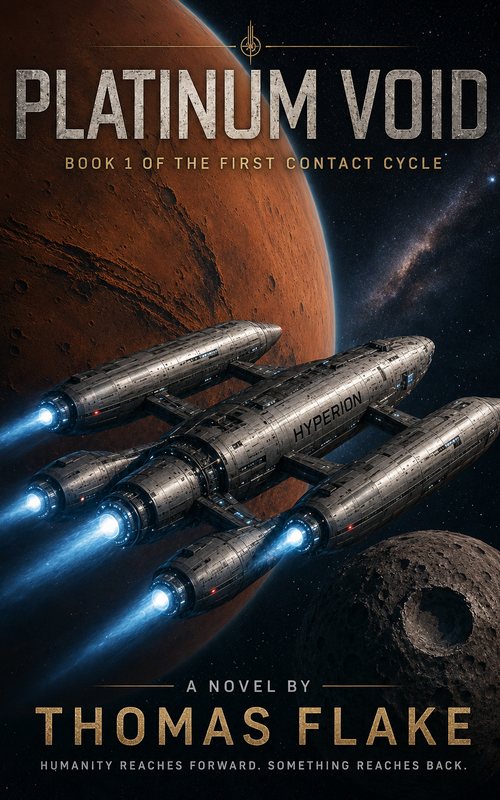
Elias Grant — a geologist, not a hero — sits in a failing lunar shelter with a ticking oxygen gauge and turns his telescope on the one thing left worth watching: the Hyperion, humanity’s deep-space ship, taking on her last fuel before she lights her engines and goes. He means it for a final sunset. Years later, from a loud house on the Oregon coast, he sets down what it truly began — the only honest account of what passed between 2044 and 2048, and of a shard of metal fifty thousand years old, shaped by no human hand, that he keeps in a copper box to stop it speaking. Every trajectory in the book was flown in the simulator first; where the mission would not close, the chapter changed rather than the physics.
Anticipated 23 September 2026. The excerpt below is free and stays free.
Free excerpt
The first half of Chapter One
With throats unslaked, with black lips baked,
We could not laugh nor wail;
Through utter drought all dumb we stood!
I bit my arm, I sucked the blood,
And cried, A sail! a sail!
Samuel Taylor Coleridge, The Rime of the Ancient Mariner, 1798
Chapter One: Tanker 103
26 to 31 May 2044
Call me Grant.
Not Doctor Elias Grant. Not NASA Senior Geologist. Not any of the titles the world once pinned to my chest like medals on a dead man's coat. Just Grant. That is the man who matters to this account: not the scientist with the credentials but the one standing inside a half-dead lunar shelter with his eye pressed to a telescope, while four hundred thousand kilometers away the future of the human race topped off its fuel tanks.
I am writing this from a small house on the Oregon coast, years after the events I am about to describe. The Pacific is loud today, the way it always is in November, and the salt air finds the window frames no matter how often I re-caulk them. I chose the house for the noise. The surf covers other sounds, or the memory of them: the low hum that lived in every bulkhead of the Hyperion, the breath of recycled air down a hundred meters of crew hull, and beneath both, felt more than heard, the vibration of twelve concentric shells of molten sodium turning against one another, the innermost at three thousand six hundred revolutions a minute and every shell outside it slower than the last, wheels within wheels, winding a magnetic field tight enough to hold the killing radiation of deep space at arm's length. You do not forget a sound like that. It enters the bone in the first week and it stays, long after the hum has become the crash of water on basalt, long after you have closed your eyes and asked it to stop.
On the worktable beside me, inside a Faraday cage the size of a cigar box that I cut from quarter-inch copper and soldered shut at every seam, lies a metal shard the length of my index finger. It is tapered at both ends. Its surface cannot decide between smooth and crystalline; the choice it makes depends on the light. The isotopes put its age near fifty thousand years. The hands that made it were not human hands. It has sent no signal I can measure, but the cage is the reason I cannot measure one, and I would be a fool to mistake my own deafness for its silence. I built the box to keep it from speaking. It was a long time before I understood that the box does nothing to keep it from listening.
One true thing, before the sequence begins: the shard was not made on Phobos. Where it was made, and by what, I will come to, or I will not; the manuscript will decide that before I do. What I can tell you here is that the place we found it was not the place it began, and that the place it began appears on no chart any astronomer I trust has been willing to publish. I have kept the rest for the pages that follow, because some things must be earned in sequence, and because I am writing this for one reader in particular, and she is more careful than I am, and she deserves the discoveries in the order they were paid for.
If you are reading this, you are that reader, or you have taken her place. Either way, understand what you are holding. This is not the record of a thing that happened and ended. It is a wire that is still live. Read on if you mean to; set it down if you do not; but do not tell yourself the choice is a small one.
This is the only true account of what passed between 2044 and 2048. What the networks broadcast, what the documentary houses cut from NASA telemetry and crew photographs, what the committees made me swear to and then leaked to suit themselves. All of it is incomplete, or misunderstood, or a deliberate lie. I was there from the first hour to the last. And because Elena Voss chose to set me down on Earth's doorstep as the sole surviving witness, I carry a debt that compounds with every day I leave it unpaid. This account is the payment. I intend to settle it in full.
It began on the Moon. A telescope, a dying shelter, and a woman named Rachel Kane on her knees beside a spent CO2 canister, coaxing twelve more hours out of it while I sat useless and watched the most expensive machine ever built prepare to leave the Earth for good.
* * *
Our lander, Artemis XV, had been a dead ship for seventy-one hours by the time I saw the Hyperion through that telescope.
The mission had been perfunctory, or as perfunctory as anything gets when you are landing a spacecraft on another world. Kane and I had been assigned to survey the subsurface ice deposits near the lunar south pole, mapping the extent and purity of water reserves in the permanently shadowed craters as part of NASA's long-term in-situ resource utilization program. ISRU. Everything at NASA has an acronym, and this one meant something simple: learning to live off the land instead of hauling everything from Earth. The water ice in those craters was a goldmine. Split it by electrolysis and you get liquid oxygen for breathing and liquid hydrogen for fuel. The irony of what followed is not lost on me. We had come to the Moon to study ice that could sustain human life, and instead the Moon nearly killed us.
A micrometeorite did the work. No larger than a grain of sand, moving at roughly twelve kilometers per second, fast enough that kinetic energy, not size, was the weapon. It struck during final descent, punching through the thermal blanket, the micrometeorite shield, and the outer sheath of the descent-stage propellant feed that carried unsymmetrical dimethylhydrazine to the engine. There was no warning. No alarm. The cabin instruments showed a pressure drop in the fuel line so slight that the software flagged it as a sensor anomaly rather than a leak. By the time Kane recognized what was happening, by the time she saw the descent-engine thrust curve begin its slow, fatal droop, we were two hundred meters above the surface and falling too fast.
She fought the stick. I want that on the record. Rachel Kane, Lieutenant Commander, United States Navy, veteran of three prior spaceflights and seven hundred hours of extravehicular activity, fought the controls of that dying lander with everything she had. She cross-fed oxidizer to compensate for the falling fuel pressure. She adjusted the descent angle to buy time. She managed to cut our impact velocity from what would have been a lethal twenty meters per second to something merely catastrophic: eleven. But eleven meters per second is still twenty-five miles an hour, and when one landing leg hit a boulder and the others buckled, the lander tipped, caught its edge, and cartwheeled across the regolith in a slow-motion tumble that gave us, between impacts, whole seconds to anticipate the next one. My helmet visor cracked but sealed. Kane's left wrist snapped against the armrest. We slid to a stop at the bottom of a shallow crater, inverted, dangling from our harnesses, alive.
The lander was finished. Every drop of propellant we needed to return to lunar orbit was evaporating through a hole I could have covered with my thumbnail, sublimating into the vacuum in an invisible plume that would have been lethal to breathe and was now simply wasted. We had suits, emergency oxygen, and a three-kilometer walk to the nearest shelter.
Kane and I had known each other for two years. We'd been paired for Artemis XV because our skill sets were complementary, her piloting and engineering, my geology and field science, and because we had the kind of professional rapport that mission planners look for in two-person crews: mutual respect, easy communication, a shared tolerance for bad coffee and long hours in simulators. She was thirty-eight, former Navy test pilot, built like a distance runner, with a trenchant wit that could cut glass and a competence so thorough it occasionally made me feel redundant. I was forty-two, NASA lifer, sixteen years with the agency, divorced, with a nine-year-old daughter in Houston named Maya who thought my job was "looking at rocks on the Moon," which was honestly not far from the truth. She was right about my job and wrong about the scale of the Moon, both of which are common errors at nine.
We made the walk in our suits. Three kilometers on the Moon sounds manageable until you're doing it in a pressure suit rated for six hours of EVA, over terrain that has never seen wind or water or any erosive force gentler than a billion years of micrometeorite bombardment. The regolith was sharp. The boulders were unweathered, their edges as keen as the day they were blasted free by impacts millions of years ago. Lunar gravity, one-sixth Earth's, made each step efficient but treacherous, a bouncing gait that could turn an ankle or pitch you face-first onto a rock that would puncture your suit before you could get your hands out. Kane walked the entire distance with a broken wrist clamped against her chest, her breathing ragged but controlled on the suit radio. She did not complain. She set the pace, picked the route, warned me twice about loose footing, and did not say a word about the pain. That was Kane. I have met many brave people in my career. She was the most competent.
Shelter Seven was a pressurized cylinder about the size of a school bus, positioned on a low ridge within walking distance of several permanently shadowed craters. NASA's Artemis infrastructure program had been placing these emergency habitats near landing sites since the early 2030s, each one stocked with oxygen, water, food, power cells, a CO2 scrubber, and basic medical supplies. In theory. In practice, Shelter Seven had been treated as a supply depot by at least three subsequent missions, each one borrowing consumables with the vague institutional promise that replacements would arrive on a future cargo flight. The replacements had not come.
We cycled through the airlock and took stock. The main oxygen tanks read twelve percent. The water recycler had been partially dismantled, someone had taken the primary filter cartridge and two of four condensation coils, presumably for a repair elsewhere. The lithium-hydroxide CO2 scrubbers were down to their last canister. The power cells showed eleven percent and falling, with the solar array producing barely enough to offset standby loads. I ran the numbers on my suit computer while Kane splinted her wrist with medical tape and a tongue depressor from the first-aid kit. If we sealed off the rear compartment to reduce the environmental load, if we kept our exertion to a minimum and our breathing slow, we had perhaps forty-eight hours of survivable atmosphere remaining. After that, the CO2 concentration would cross the threshold where headaches become confusion and confusion becomes unconsciousness, and shortly after that we would stop being a problem anyone needed to solve.
I am a geologist. I study the composition and deep history of planetary bodies, the slow drama of magma chambers and tectonic rifts, the inveterate work of erosion and deposition. I can identify a chondrite meteorite by the pattern of its chondrules and tell you the thermal history of an igneous intrusion from a thin section under a petrographic microscope. What I cannot do is rebuild a water recycler from two missing condensation coils and a primary filter cartridge some previous mission had requisitioned and never replaced. Kane could. Or at least she believed she could, which in our situation amounted to the same thing.
So while I watched the sky, Kane suited up and went outside to work on the shelter. Without more watts the CO2 scrubber and what remained of the environmental system would shut down long before the oxygen ran out. The fix was on the roof. Two of the four solar panel assemblies had been knocked out of alignment, whether by micrometeorite strikes or thermal cycling or simple age, no one would ever know, and the junction box where they fed into the shelter's power bus had failed contacts. Someone on a previous mission had used aluminum lugs on the copper bus bars instead of spec, and years of lunar thermal cycling, three hundred degrees of swing every fourteen days, had worked the dissimilar metals loose at every junction, fretting the contact surfaces into a layer of resistive oxide that was dropping half the voltage before it reached the batteries. Kane cycled through the airlock with one good hand and one she could barely close into a fist, climbed the access ladder bolted to the shelter's hull, and began cleaning contacts and re-aiming panels using a multitool and a roll of conductive tape from the repair locker. Working in a pressure suit, on the roof of a cylinder in one-sixth gravity, with a broken wrist. That was Kane. She did not wait for rescue. She engineered time.
I stayed at my post. Not out of cowardice, though I have examined that question on certain bad nights, but because the shelter had two assets that justified my presence: a radio link to Houston, and a telescope. The radio was keeping us connected to Earth, relaying our status, receiving whatever slim hope Mission Control could offer. But the telescope was mine. And Kane's repairs were working. By the time she had been on that roof for six hours, the power cells had stopped falling. The solar array output had doubled, then tripled. The CO2 scrubber hummed along on borrowed time, its last canister stretching further than it had any right to because Kane had rigged a bypass that recirculated partially scrubbed air through a secondary pass. My original estimate of forty-eight hours had come and gone. Kane's repairs bought the days that followed, and by the third one, seventy-one hours after the crash, I sat down and recalculated. Accounting for the improved power and the scrubber bypass, I put our remaining window at roughly sixty hours. Maybe seventy if we stayed still and breathed slow.
* * *
Mounted in the dome above the shelter's main compartment, bolted to a vibration-isolated platform that was itself anchored to the lunar bedrock, was a ten-meter segmented-mirror telescope. It was a Keck-class instrument, one of a small number of astronomical observatories placed on the lunar surface during the Artemis infrastructure program. The Moon is the finest optical platform in the inner solar system. No atmosphere means no turbulence, no refraction, no absorption bands, no scattered light from a sky that doesn't exist. A telescope on the Moon is diffraction-limited: its resolution is constrained only by the diameter of its primary mirror and the wavelength of the light it collects. At visible wavelengths, centered around five hundred and fifty nanometers, a ten-meter aperture yields an angular resolution of roughly fourteen milliarcseconds. The practical result: at the Earth-Moon distance of 384,400 kilometers, that telescope could resolve features approximately twenty-five to thirty meters across. The optics were not pristine, years of micrometeorite pitting and electrostatically lofted regolith dust had degraded the mirror's reflectivity, but they were good enough. The telescope had been left behind at Shelter Seven because it was too massive to move and too precisely aligned to survive transport. Someone had decided it was cheaper to abandon than to relocate, and that bureaucratic indifference was about to become the luckiest accident of my life.
I did not turn the telescope toward the Hyperion's fueling orbit because I expected rescue. I did it because I am a scientist, and scientists observe things, and because the alternative was to sit in a dying shelter and count my remaining breaths, and I refused to do that. I had been following the news from Earth between mission prep sessions and knew that today, May 28, 2044, was the scheduled date for Starship Tanker 103 to deliver the final propellant load to the Hyperion. Everyone in the aerospace community knew. It was the biggest story in spaceflight, the capstone of a logistics campaign that had consumed over a year of continuous launch operations. I wanted to see it, the way a condemned man might want to watch one last sunset. Something beautiful and purposeful and alive, to counterbalance the dying shelter and the ticking oxygen gauge.
I focused the instrument on her fueling orbit, the long ellipse she had climbed to from her construction dock, its high point just under the height of the geostationary belt.
What I found put the dying shelter out of my mind.
The Moon's sky is blacker than any darkness you have known. That is not poetry; it is physics. There is no atmosphere to scatter photons, no haze to soften the terminator line between day and night, no mercy built into the optics of that sky. Stars do not twinkle on the Moon. They burn with a hard, unwavering light that makes the constellations look engraved on black glass. Against that absolute dark, anything that reflects sunlight stands out with savage clarity.
The Hyperion was near the top of that ellipse, four hundred thousand kilometers away, and through the ten-meter mirror she was the most extraordinary thing I had ever seen.
* * *
I had followed the Hyperion program the way everyone in the aerospace world had, with a mixture of professional awe, private skepticism, and poorly concealed jealousy. Elena Voss had announced the project in 2036, eight years before I found myself squinting through a dusty telescope on the Moon. By then she was the world's first female trillionaire, and only the third person to cross that threshold, her fortune built on reusable launch vehicle patents, orbital propellant-depot infrastructure, and a series of strategic acquisitions that had consolidated roughly forty percent of the global commercial launch market under her company's control.
The public version was that the company had survived its founder and grown more disciplined under the widow who inherited it. The private version, I learned later, was less clean. Thomas Voss, a propulsion engineer of considerable ability and Elena's husband, had died in 2033 during a static-fire test of an early Starship-derived vehicle, a pad explosion that killed three other crew and generated a congressional investigation Voss endured with a silence the press interpreted as either devastating grief or cold indifference, depending on the outlet. She never remarried. She retreated from public life almost entirely. She funded the Hyperion out of personal accounts, accepted no government partners, and answered no questions from oversight bodies on the grounds that the ship was private property built with private capital for a private mission.
That mission was, on its face, straightforward: fly to the asteroid 16 Psyche, extract its platinum-group metals, and return with enough refined material to make Voss the first human being in history with a net worth measured in quadrillions. The asteroid had been studied extensively. NASA had even sent a dedicated probe to orbit it years earlier. Psyche was approximately 220 kilometers across and composed almost entirely of iron and nickel laced with platinum, palladium, iridium, and osmium. Conservative estimates valued its metal content at figures that made the word "trillion" feel quaint. Voss intended to claim it.
Through the telescope I could see her in orbit, docked nose-to-nose with Starship Tanker 103, the propellant delivery vehicle completing the final fueling sequence. Between the two hulls hung a faint brightening, a smear of light against the dark that I took for venting, propellant or coolant catching the sun. At this distance I could not make out the transfer umbilicals or the robotic arms or any drift of crystals. I could see only the two shapes joined nose to nose and the pale haze between them.
She was not sleek. She had the functional, almost brutal aesthetic of a machine designed to survive the void rather than to impress anyone looking at it. At the mirror's resolution she was a single thick column, perhaps thirty meters across and the better part of two hundred long, and the column was not smooth. Its edges broke the light unevenly, ridged and bristling, and I took it for a cluster of cylinders bundled lengthwise rather than a single hull, though I could not separate one from another at that distance. One end tapered toward the docking interface where Tanker 103 still hung. The other was blunt and heavy, the weight of her gathered there. What she carried, how she was divided inside, who rode where and what ran where, I would not learn until I was aboard her.
That blunt end was where whatever drove her was clustered, a darker, denser mass at the foot of the column, engines too small and too many for the mirror to count or resolve. Their number, their name, and what it would feel like to ride them, I would learn later. From the Moon they were only a shadow of weight at the base of the ship, the part of her that promised she could move, and move hard. She looked less like a spacecraft than an industrial cathedral stood on end: tanks, struts, conduit, and the cold promise of merciless thrust.
I keyed the private channel to Kane on the roof.
"Rachel," I said. My voice was steady only because I had spent three days practicing steady. "You need to see this."
She didn't respond right away. I heard the faint vibration of her boots shifting on the hull above, transmitted through the shelter's structure, the only way sound travels on the Moon. When she spoke, her voice was hoarse.
"If it's not a rescue ship, Grant, I swear to God I'm going to scream."
"It's the Hyperion," I said. "They are launching."
* * *
The tanker undocked. I watched the two vehicles separate, the tanker easing backward on a gentle push of cold-gas thrusters. For a moment the Hyperion hung motionless in the black, and she hung nowhere near the Earth. That is worth saying plainly, because every painting of that morning I have ever seen puts her against the blue, and she was not against the blue. She was at the top of her ellipse, out at the height of the geostationary belt, which from where I sat put her a good five degrees clear of the Earth's disk, five or six times the width of the planet away from the edge of it, alone in a field of stars with the tanker backing off her nose. She was up there for one reason and it was the same reason Elena Voss did everything. Fourteen months of tanker flights had carried her propellant up the well in a hundred small increments so that the ship would not have to carry it up herself, and the ship had been walked out to the top of that ellipse ahead of time, so that when she finally lit her engines she was already most of the way out of the Earth's gravity and the burn she had to make was the smallest burn that would do the job. The fleet paid the bill a hundred times in cheap money. The ship paid once, in the only money that mattered to her, which was the propellant she would still be carrying when she got where she was going. A silver bundle suspended in the void, five degrees off the shoulder of the world.
Then the engines ignited, all of them at once, and the result was visible from the surface of the Moon without a telescope.
I did not need the eyepiece. Through the dome's bare glass I saw a new star appear near the Earth, a hard white point that had not been there a moment before, brighter than any star around it and steady as a lamp, unwinking because there was no air between us to make it tremble. It was not bright enough to cast a shadow; nothing a third of a million kilometers away could do that. But against the black it was unmistakable, and I knew what it was. Through the telescope, with the filter dialed down two stops to keep from saturating the detector, the point held, the brightest thing in the field. I could not resolve the plume. I did not need to. The Hyperion was burning out of Earth orbit, on a departure vector I could not yet read from a single observation.
The burn lasted just over four minutes. I know that now from the flight logs; at the time I was counting heartbeats, each one a small explosion in my chest. Whatever drove her was consuming propellant at a rate that would have drained a conventional rocket dry in seconds, and it pushed the whole vast mass of her out of Earth orbit and up to nearly three kilometers per second. From the surface I saw only the star, hard and white and steady, until, just over four minutes in, the engines cut off, all at once, and the new star winked out as though someone had thrown a switch. One moment the Hyperion was a blazing point of light; the next she was gone, not destroyed, just dark, coasting on the velocity that four minutes of concentrated violence had given her. I tracked her through the telescope as a dim, sun-lit shape moving against the star field, already receding from Earth on a trajectory I could not yet read.
Off on the long road to Psyche, I assumed, like everyone else who had followed the program.
Within minutes, barely enough time for the light of that engine cutoff to reach Earth and for Houston to compose a reply, the suit comm crackled on the emergency frequency.
"Artemis XV, Houston. Priority relay from Johnson Space Center." The CAPCOM's voice was controlled but I could hear the tension underneath. "We've been contacted by the private vessel Hyperion. Their commander is offering to divert for rescue operations at your position. They say," a pause, and I could hear paper rustling, someone reading a message they didn't fully understand, "they say they have the delta-v and life-support capability to reach your position within your consumables window. Their commander has authorized a full diversion. They're telling us approximately sixty-eight hours."
Sixty-eight hours. I ran it against both of my numbers and got two different answers, which is the part nobody puts in the retellings. Against seventy, the figure I had arrived at by assuming the two of us would lie still and breathe like sleeping men for three days, we had two hours of margin. Against sixty, the figure I actually believed, we were dead eight hours before anybody got here. And the seventy existed at all only because Kane had spent six hours on a rooftop in a pressure suit with a broken wrist, cleaning corroded contacts and re-aiming solar panels.
Another pause from Houston. Then, in a tone that cracked slightly at the edges: "We can't independently verify the timeline, but this is the only offer on the table. Hang tight, guys."
Kane's voice came back on the private channel, raw and ragged with something between relief and exhaustion. "Copy that, Houston. Tell them thank you." A beat. Then, to me: "Grant, did you hear that? Sixty-eight hours."
"I heard it. I make our margin at about two hours. Maybe three."
A long silence on the channel. I could hear her breathing, slower now, deliberate, the cadence of someone doing arithmetic with stakes attached. "Then I'm staying up here," she said. "The scrubber bypass is holding but the number three panel keeps drifting. If it drops below forty degrees off-axis we lose a third of our power and your sixty-hour estimate becomes forty-four."
"Rachel,"
"Don't. I can do this. Go watch your telescope."
That was the moment, I think. Just a woman with a broken wrist telling me she was going to stay on a rooftop in hard vacuum for as long as it took to keep us both breathing, and the sound of her voice, calm, certain, obstinate, doing something to the inside of my chest that I did not have a name for. Not then.
But that is later. This is the rooftop, and the margin, and the math.
Between us and Earth, the Hyperion had burned for just over four minutes, driving fifty-five thousand tons of ship out of Earth orbit and up to a coasting velocity of nearly three kilometers per second. Now her engines were dark and she was crossing 384,400 kilometers of vacuum on momentum alone, a ballistic arc, silent and unpowered, the way a bullet crosses a room after the muzzle flash has faded. I assumed, watching her come, that the rescue was costing Voss the mission itself, that every ton she burned for us was a ton she would not have for Mars. I had the shape of it right and the size of it wrong. The burn I had watched, nearly thirty thousand tons of cryogenic propellant spent in four minutes, was not the burn she had filed; she had meant to leave two days later and go straight to Mars. The Moon was not on her flight plan until we were. What we cost her was the diversion itself, methane spent at the departure burn and spent again at the brake, methane the lunar depot could not give back, because the depot cracks ice and ice carries no carbon, paid out of a margin I would later watch her count the way other people count heartbeats.
* * *
The good news lasted about forty minutes.
I had gone back to the telescope, because that is what I did, and because there is a particular kind of restlessness that comes over a man who has just been told he will probably live. Kane was still on the roof. We were talking, on the private channel, about ordinary things, which we had not done in three days. And then Houston came back on the emergency frequency, and the CAPCOM's voice had changed. The tension was still there. What had been added to it was embarrassment, which is a hard thing to transmit across four hundred thousand kilometers and which came through anyway.
"Artemis XV, Houston. We have a problem with the rescue geometry. Stand by."
We stood by for eleven minutes. I have listened to that gap on the recordings. There is nothing on it, only the carrier hiss and, twice, someone in the background of the Houston loop saying a number and being told to say it again. Kane came down off the roof during the ninth of them, cycled through without a word, and stood in the middle of the shelter with her helmet still on and frost smoking off her shoulders.
Then: "Artemis XV, Houston. Hyperion's approach is an equatorial capture. Their depot is in an equatorial orbit and they are going there for oxidizer before they leave. Their shuttle cannot reach your latitude."
Kane took her helmet off. "Say again the reason."
"It's a plane change, Commander. They're coming into a lunar orbit inclined zero degrees. You are at eighty-nine point five south."
I did not need it explained and neither did Kane, but I am going to explain it here, because in my experience the people who read accounts like this one have been told a hundred times that space is big and never once that space is a set of nested constraints, and the second fact is the one that kills you.
An orbit is not a place. It is a plane, and the plane passes through the center of the body you are orbiting, and it has an orientation in space that is enormously expensive to change. A spacecraft in a circular orbit a hundred kilometers above the lunar surface is moving at about one point six three kilometers per second. To swing that orbit ninety degrees, to take a path that runs around the Moon's equator and tilt it until it runs over the Moon's poles, you must change your velocity vector by very nearly one and a half times your orbital speed. Two point three kilometers per second. That is not a course correction. That is more than the entire budget for landing on the Moon and taking off again.
Voss's shuttle carried enough propellant to come down to the surface, sit, and go back up. It did not carry enough to do that from an orbit ninety degrees away from the one its mother ship was in, and no amount of goodwill was going to change the arithmetic. The Hyperion herself could have made the turn. She could have made it twice. But she would have paid for it in the propellant that was supposed to take her to Mars, and she had already spent margin she could not replace on the burn that was bringing her here, and there is a difference between a woman who will spend a fortune to save two strangers and a woman who will spend the mission.
I did not know, at the time, that Elena Voss had already run those numbers and found them unaffordable, or that she had asked for a second option before she asked for a first. I learned that later, from the log. What I knew, sitting in that shelter with a headache behind my eyes and my hands going cold, was that the ship I had watched burn out of Earth orbit was going to arrive on schedule, park in an orbit I could see from where I sat, and be as far out of reach as if it had never come.
"Houston," Kane said. "Are you telling us they can't get us."
A pause. "We're telling you they can't get you there."
It took me a moment. Kane got it first. I watched her face change.
"There," she said. "You mean we move."
* * *
What Houston proposed, and what took them the better part of the next four hours to be willing to say out loud, was that we walk to the mine and put ourselves on a freight train.
I should explain the railroad, because almost nobody outside the industry knew it existed and because it is the reason I am alive to write this.
Water ice on the Moon is at the poles. It is at the poles because the poles have craters whose floors have not seen sunlight in two billion years, cold traps at forty kelvin where anything that wanders in stays. Everything you want to do with that water, however, you want to do at the equator. You want to lift it, and the cheapest place to lift from is a body's equator, where the launch geometry lines up with the plane everything else in the solar system is trying to move in. So the ice is in one place and the use for it is in another, and between them, for a mining company, sits a choice.
You can fly it. You can build tankers that lift from the polar surface, change plane in orbit, and come down at the equator, and you can pay that plane change on every single load, forever.
Or you can pay it once, on the ground, and never pay it again.
Voss Corporation had laid two thousand seven hundred and twenty-nine kilometers of rail from the south polar mining district to an equatorial lift head. Straight, because there is nothing on the Moon to go around and no property to condemn. Linear-motor drive, because in one-sixth gravity a steel wheel on a steel rail can only bite so hard, and a train that has to push against nothing but its own bearings does not need to bite at all. And fast, because the one thing a vacuum gives you for free is the absence of air, and a machine that never meets a molecule can run at any speed its track will tolerate. The consists ran at five hundred kilometers an hour, hoppers of crushed ice under the same magnetic drive that held them a centimeter off the rail, and they ran on a fourteen-hour cadence, and they had never in six years of operation carried anything that breathed.
They were not built to. That was the point of them. Every piece of infrastructure on that moon, the mines and the crushers and the rail and the lift head and the depot at the end of it, was run by automatons and built for automatons, with no life support, no habitat, no pressure vessel a human being could have gotten into and no crew return vehicle if one had. It was cheaper that way, and safer, and it is the reason there was nobody on the Moon to come and get us in the first place. I have heard people call that a failure of planning. It was not. It was the plan. Voss had built a machine that did not need people, and then two people had needed it.
The distance, at five hundred kilometers an hour, was five hours and twenty-eight minutes.
Our suits were rated for six hours.
I want to be precise about what happened next, because it has been described in three books and a documentary and every one of them got it wrong in the same direction, which is to say they made it heroic. It was not heroic. It was a medical consultation conducted over a four hundred thousand kilometer round trip with a one and a quarter second lag in each direction, and it was conducted by people who were frightened of being blamed.
The flight surgeon came on. I did not know him. He introduced himself and then he asked Kane, in the flat voice they teach you, to describe her injury.
"Left wrist," Kane said. "Distal radius. Displaced. Splinted at hour two, re-splinted at hour nineteen. I have full function in the right hand and about forty percent grip in the left inside the brace. Pain is a six. I have not taken anything for it because I wanted to be able to think."
"Commander, I need to ask you to assess your own fitness for a twelve-hour extravehicular exposure including two traverses and a five and a half hour transit on an unpressurized vehicle."
"No, you don't," Kane said.
There was a pause of considerably more than two and a half seconds.
"Say again."
"You don't need to ask me to assess it. You need to decide it. I'll give you every number I have and you can have all of them, but I am not going to tell you I'm fit and let that be the piece of paper this hangs on. I've been in the service sixteen years and I know exactly what that piece of paper is for." She shifted the brace against her chest. "Ask me the questions. I'll answer them straight. Then somebody with a name is going to have to say yes."
I have thought about that more than almost anything else she said to me. She was not being difficult and she was not being noble. She was refusing to let two hundred people in Houston hide behind her optimism, which is a thing that has killed a great many aircrew, and she was doing it while her wrist was broken and her air was running out and she had every possible reason to say whatever would get her on that train.
They asked the questions. She answered them straight. Her resting heart rate, her urine output, which was poor, the last time she had eaten, which had been eleven hours. When they got to me I found that I had less to offer. My headache had a quality I did not like, a pressure behind the eyes that moved when I moved, and my hands had been cold since the second day, and when the surgeon asked me to perform a serial sevens test I got to seventy-two and stopped, and had to start again, and got to seventy-two and stopped again.
"Doctor Grant," the surgeon said. "How is your vision."
"There is a grayness at the edges," I said. "It comes and goes. It comes when I stand up."
That is carbon dioxide. It is the first thing that goes and the last thing you notice, because the same gas that dims the edges of your visual field also removes your ability to be alarmed about it. Kane had been running the scrubber bypass for two days and it had bought us the hours we were spending on this conversation, and it had not bought us clean air, and both of us knew what the grayness meant.
The surgeon went away for nineteen minutes.
When he came back he did not give us a clearance. He gave us a condition. He said that the exposure was outside every protocol NASA had, that no flight surgeon had ever been asked to authorize a crewmember onto uncrewed commercial cargo infrastructure, that he was not able to certify either of us fit, and that he was recording his objection.
And then he said: "My objection is on the record. So is the fact that the alternative is that you stay where you are. Houston is not going to order you to do this and Houston is not going to stop you. It is your call, and I am sorry, and I want you both to know that I think you can make it."
I have met him since. He is retired now, in Colorado. He told me it was the worst nineteen minutes of his professional life and that he has never decided whether he did the right thing, and I told him he had done the only honest thing available, which is not the same and is sometimes better.
* * *
Then came the part that was mine.
The rail was Voss Corporation property and Voss Corporation knew where it was. The lift head was on their charts to the centimeter. What nobody had, in Houston or in cislunar space or aboard the Hyperion, was a route from Shelter Seven to the polar railhead that two people in pressure suits could actually walk.
There was a survey, of course. There is always a survey. The Lunar Reconnaissance Orbiter and its successors had mapped that terrain at half a meter per pixel from orbit, and the mining company had its own imagery, and between them you could produce a very confident-looking map of the ground between us and the mine. What you could not produce from any of it was the thing that matters, which is whether a slope that reads as eleven degrees in a digital elevation model is walkable in a suit or is a field of loose ejecta on a substrate of fractured breccia that will take your ankle in the first fifty meters. Orbital imagery tells you the shape of a place. It does not tell you what the place is made of, or how it behaves when you put your weight on it.
I had spent nineteen days walking that ground with a hammer.
Not on this mission. On the last one. Artemis XIII put me down in that district two years before XV, with a different pilot and a lander that worked, and for nineteen days I did the entire thing NASA sends a geologist to the lunar south pole to do: went out to the edges of the permanently shadowed regions and found out, by hand and on foot, what the regolith actually does there. Those traverse logs exist. They are in an archive in Houston and they are in my own head, which turned out to matter more. Waypoints with photographs and grain size distributions and, at forty-one stations, a note in my own shorthand on trafficability, which is a word that means whether you can walk on it, and which I had written down forty-one times without once imagining that I would need it.
I had come back on XV to extend that survey west, and I had thought of the whole of it, sitting at the telescope, as the thing I would not get to finish. I had actually said so to myself, in those words, in the small hours of the second day. It turned out to be the only thing either of us had that nobody else in the solar system could supply.
I laid the traverse chart out on the deck and I picked a route. Six point two kilometers, north-northwest, staying off the crater rim and taking a longer line along a ridge of coherent highland breccia that I had walked twice and knew to be competent ground. It added nine hundred meters and it avoided a slope I would not have put a rover on. I gave Houston the waypoints in selenographic coordinates, latitude, longitude and elevation, and Kane read them back to me one at a time and I confirmed each one, and then she read them to Houston, and Houston read them to the Hyperion, and forty minutes later a voice I had not heard before came back through four hundred thousand kilometers of vacuum and said that Penumbra had checked my route against the company's own imagery and concurred, and that the ship had a question.
The question was what my confidence was in station thirty-one.
Station thirty-one was a fifty meter stretch where the ridge narrowed and I had written, on the eleventh day, in a suit glove, using the shorthand of a man in a hurry: comp, poss dust pond E side, avoid E.
I said that I was confident, that the west side of the neck was competent bedrock, that the east side was a dust pond and that a dust pond on the Moon is a trap with no bottom that anybody has measured, and that whatever they did they should keep us west.
There was a pause of about a minute and a half. Then the voice said: "Hyperion copies. West of station thirty-one. Doctor Grant, the commander asks me to tell you that your survey is the only piece of new information anyone has contributed to this problem."
I sat on the floor of a dying shelter and put my hands over my face, and Kane, who understood exactly what had just been said and to whom, had the grace to look at the wall.
* * *
There was one train.
That is the whole of it, and it is worth sitting with for a moment, because a fourteen-hour cadence sounds generous until you put a deadline on the far end of it. The consist we needed pulled out of the polar loading yard at what my log calls hour one twenty-nine and a half, which is to say at half past nine in the morning on the thirty-first of May, Greenwich time, on a moon where those words mean nothing. Five hours and twenty-eight minutes on the rail. An hour at the far end to cross from the lift head to the pad the Shackleton would come down on. The Hyperion would brake into lunar orbit at hour one thirty-seven and a half and the shuttle would be on the surface not long after, and if we were not standing on that pad when it got there the next train was fourteen hours behind us and our air was not.
Work backward and you get a departure from Shelter Seven at hour one twenty-six. Two hours to walk six point two kilometers, which is slow, and which I insisted on, because I had done that walk rested and I was not rested.
Three clocks, and not one of them was ours to set.
The first was the Hyperion's. Voss had filed a departure two days later than the one she flew and a route that did not touch the Moon at all, and the crossing she was flying was the fastest one that closed: sixty-six hours from the Earth departure burn to the lunar brake, which is a hard three days for fifty-five thousand tons and which she was paying for in methane she could not replace until Mars. She could not arrive sooner. She had already spent everything that would have bought sooner, before we ever knew her name.
The second was the railroad's. Fourteen hours between consists, a cadence set six years earlier by a scheduler optimizing liquefier throughput, indifferent to us in a way I find restful to think about now. Hour one twenty-nine and a half was not the train we wanted. It was the train there was.
The third was ours. It was six hours long and we were going to be wearing it.
Lay all three side by side and they converge, inside about two hours of each other, on a graded circle of regolith at zero degrees latitude at the far end of a mining railroad, and every party to it had already pushed their own clock as hard as it would go and none of them could push it further. That is what a rescue actually is. It is not one heroic act by one person. It is three or four separate parties spending everything they have, each in a different currency, and arriving at the same patch of ground at almost the same minute, and finding out only afterward how close it had been.
Which left us fifty hours to wait.
Kane came inside after eight more hours on the roof. She had re-aimed the number three panel, reinforced two of the junction contacts with strips of aluminum cut from a food container, and gotten the array output to a level she pronounced "ugly but stable." She cycled through the airlock, removed her helmet and gloves, carefully, wincing as the medical brace caught on the cuff, and sat down on the floor beside me. Her face was the color of lunar dust. Dark circles had settled under her eyes like bruises. I handed her the last water pouch. She drank half, handed it back.
"You need to sleep," I said.
"So do you."
"I'll watch the scope. If anything changes,"
"You'll wake me." She looked at me. Three days of lunar grime on her face, hair matted flat from the helmet liner, eyes red-rimmed and exhausted, and I have never in my life seen anyone more beautiful. She did not know that. I did not say it. I pulled the emergency blanket from the med kit and draped it over her shoulders, and she leaned against the wall beside the telescope mount and closed her eyes. She was asleep in thirty seconds. I sat beside her and watched the oxygen gauge tick downward and listened to her breathe.
I have been asked, more than once, what we talked about. The honest answer is that we mostly did not. There is a kind of waiting that fills up with conversation and a kind that empties out, and this was the second kind. Kane slept in long blocks, deliberately, the way you sleep before a night launch. I slept in fragments and woke each time to check the scrubber readout and the power levels and the slow, ineluctable progress of the dot on my supply-manifest chart. The CO2 gauge crept upward in imperceptible increments. The temperature dropped as the power cells fought to keep the heaters running.
Twice in those fifty hours Kane suited up and went back onto the roof, not because the array needed her but because she had decided that the difference between an eleven-hour-old repair and a fresh one was the difference between arriving at the railhead with six hours of suit and arriving with five and a half. She came in the second time and told me the number three panel had drifted again and that she had shimmed it with a strip of the same food-container aluminum and that it would hold for two days or forever, and that either was long enough.
I spent the hours on the telescope, and on the traverse chart, and on a letter to my daughter that I wrote four times and did not send, because the uplink budget was for telemetry and because I could not find a way to write it that was not either a lie or a goodbye. I have that letter. It is in a drawer in this house. I have never shown it to her and I am no longer certain whether that was a kindness to her or to me.
I thought about the fact that the most powerful privately-built spacecraft in history was coasting across a quarter-million miles of vacuum to pick up a stranded pilot and a geologist, and I could not decide whether that made us the luckiest people alive or the most expensive rescue in human history.
And I watched her come.
Fifty-two hours after the departure burn, with our CO2 concentration at a level that was giving me a dull, persistent headache and making my vision swim at the edges, I saw the Hyperion again through the telescope, and this time she was close enough to resolve.
She had flipped.
It happened while I had been asleep during one of my twenty-minute fragments, and I cursed myself for missing it. But the evidence was unmistakable. Through the ten-meter mirror I could now make out the bundle's blunt geometry, the cluster of cylinders and the broad disk of engines at the stern, and the orientation was reversed. The engine bells, which should have been facing away from the Moon and trailing on the far side of the ship, were now aimed directly at us. The ship had rotated 180 degrees around its center of mass sometime in the last hour, a slow and deliberate pirouette executed by reaction-control thrusters along the spine, and was now flying backward, engines forward, ready to brake.
I would not be at the eyepiece when she fired. That was the arithmetic. The brake came at hour one thirty-seven and a half and we walked out of the airlock at hour one twenty-six, and the ship that had come four hundred thousand kilometers to collect us was going to make her most spectacular maneuver over an empty shelter with the dome light off and nobody watching through the finest telescope in the inner solar system.
I want to record that I minded. It is a small and ridiculous thing to have minded, and I minded it a great deal.
* * *
We left Shelter Seven at hour one twenty-six on the thirty-first of May.
There was a checklist and Kane ran it, one-handed, the way she ran everything. Suit integrity. Consumables at ninety-eight percent, because we had stayed on shelter supply until the last possible minute and taken the disconnect standing in the airlock. Comm check on two channels. The medical brace cinched down and taped over so that no part of it could catch on a cuff or a handhold. She took the last two lithium-hydroxide canisters out of the shelter's rack, which were spent for shelter purposes and not entirely spent for suit purposes, and clipped them to her harness, and when I asked her why she said, "Because they are not doing anything here."
I did three things before I cycled out.
I capped the telescope. I do not know why. It was a reflex from twenty years of field instruments and it made no sense at all, given that the shelter would be dark and unpressurized within a week and the mirror had been degrading under micrometeorite pitting for a decade. But it had shown me the ship. I put the cap on it.
I set the shelter's beacon to continuous and left the radio powered, so that when somebody eventually came back to Shelter Seven they would find a transmitter and not a mystery.
And I took my sample bag. It was not much of a bag. Eleven samples, a little under a kilogram, picked up three hundred meters at a time on four short walks out toward the crater lip while Kane was on the roof keeping the two of us alive, because I could not sit still and because a geologist inside walking distance of a permanently shadowed crater who does not put a hammer on it is not a geologist. Kane watched me clip it to my harness and did not say anything about the mass, which at one-sixth gravity was not the problem, or about the volume, which in a suit is always the problem, or about the fact that a man being evacuated from a dying shelter onto an unmanned ore train had elected to bring rocks. She had just heard a two-year-old survey of mine read back to us from a ship four hundred thousand kilometers away, and I think she had arrived at a private position on the subject of my rocks.
Then we went outside for the last time, and the shelter that had kept us alive for five days became, behind us, a gray cylinder on a gray ridge, and neither of us looked back at it that I saw.
* * *
Six point two kilometers, north-northwest, in permanent shadow.
I have to try to give you the shadow, because it is the part that people who have not been there cannot construct. The floor of a polar cold trap on the Moon is not dark the way a room at night is dark. It is dark the way the inside of a sealed box is dark, and then it is colder than anything in your experience by a margin that makes the word cold useless. Forty kelvin. Two hundred and thirty-three degrees below zero on the Celsius scale. Nitrogen would be a liquid there and oxygen would be a liquid and if you poured out a cup of air it would puddle. Our suit lights threw two white cones onto ground that had not been lit since before there were primates, and outside those cones there was nothing, not blackness, an absence, and above us the stars burned in their hard unwinking way and gave no light at all to see by.
We walked in the cones. Kane set the pace, as she had on the first walk, and picked the route off my waypoints, and warned me twice about loose footing.
At station thirty-one the ridge narrowed to a neck about fifty meters long, and on the east side of it the surface changed. In my suit lights it looked like nothing at all: a smooth, faintly bluish flatness, level as a poured floor, prettier than any other ground I had seen on that moon. That is what a dust pond looks like. It is a hollow that has been collecting the finest fraction of the regolith for a billion years, particles a few microns across, uncompacted, electrostatically fluffed, sorted by gravity and by the slow shivering of thermal cycling into a substance that has the density of a snowdrift and no cohesion whatsoever. Nobody knows how deep they go. Nobody has measured one. It would have taken us with no more sound than the rest of that place made.
We went west of it, on competent bedrock, single file, with Kane in front.
Two hours and eleven minutes. My suit read three hours and forty minutes remaining when the mine's perimeter lights came up over the ridge ahead of us, which was eleven minutes worse than my plan and about what I had expected from a man whose serial sevens had failed twice.
* * *
I had seen photographs of the polar mining district. Everyone had. They were part of the standard press package: wide shots of the crusher gantries under floodlight, the long low profile of the electrolysis hall, an Atlas unit standing at the lip of a crater with its amber eyes and its patient stance, put there by a photographer who understood that the machine looked like a man and would sell better for it.
What the photographs do not carry is that the place is not quiet in the way the rest of the Moon is quiet. Everything there was moving. Not fast, and not loudly, because there was nothing to be loud in, but constantly: gantries tracking, conveyors running, a crusher somewhere dropping its load on a cycle you could feel through your boots as a soft repeated thud in the bedrock, and the automatons going about it all with that terrible unhurried competence, none of them looking at us, none of them stopping. There were forty-one machines working within the perimeter and not one of them registered our arrival in any way, because nothing in their task set included the arrival of people, and I understood then, standing at the edge of it, exactly what Elena Voss had built and exactly why nobody had been able to come and get us.
It was the loneliest place I have ever stood and it was full of activity.
We had seventy-nine minutes and two things to do.
The first was oxygen. Our suits were three hours and forty minutes from empty and the ride was five and a half, and this is where the mine either saved us or did not.
A lunar ice plant is, at its heart, an electrolysis stack. You mine ice, you clean it, you melt it, you run current through it, and you get hydrogen and oxygen. The oxygen then goes to a liquefier, because liquid is how you store it and how you sell it, and the liquefier is a large and complicated machine at the end of a large and complicated pipe. Which meant that upstream of that pipe, between the electrolysis hall and the liquefaction plant, there had to be a run of gaseous oxygen at moderate pressure. Not cryogenic. Not the product. The intermediate.
Kane found it in eleven minutes, on a service gantry, in a bank of purge and sampling ports that existed so that the plant's own diagnostics could take a bottle of gas off the line whenever the automatons wanted one.
"Grant," she said. "This is a quarter-inch fitting and my suit charge port is a quarter inch and I have been staring at that coincidence for ninety seconds trying to find the catch."
There was a catch. Two of them. The line ran at fourteen hundred kilopascals and a suit charge port expects about eight hundred, and there was no regulator between the port and us because a regulator is not something a purge tap needs. And the gas coming off an electrolysis stack is wet, which in a suit loop is a problem you discover about ninety minutes later at a temperature where water is a solid.
She solved the first one by not opening the valve all the way, which is an appalling thing to write down and was, in the circumstances, correct: she cracked it, watched her suit's inlet pressure, and modulated a hand valve by feel for nineteen minutes with a broken left wrist braced against a stanchion for leverage. She solved the second one by putting the plant's own sample dryer in the line, a canister of molecular sieve the size of a soup can that was sitting in a rack of six because the automatons changed them on a schedule.
I asked her, while she was doing it, whether this was safe.
"No," she said. "Turn around so you're not looking at it."
Pure oxygen at pressure will find any hydrocarbon and any speck of contamination and turn it into an ignition source, and the fittings on that gantry had been assembled by machines who had never once been asked to consider that a human lung would be on the other end. She charged my suit first. Then she charged her own, one-handed, with nobody to hold the stanchion for her.
Anticipated 23 September 2026. The excerpt above is free and stays free.